A vision-impaired
person of sound mind experiences
phantom images (visions) in
their visual field.
National helpline
1300 121 123

A vision-impaired
person of sound mind experiences
phantom images (visions) in
their visual field.
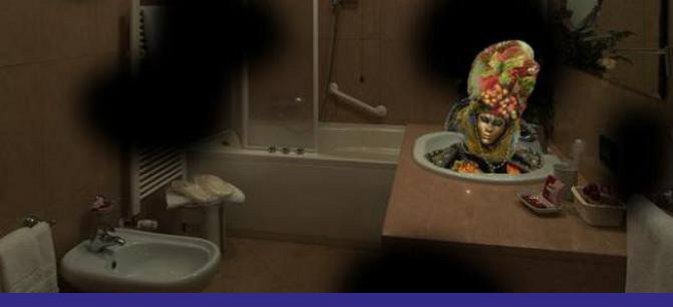

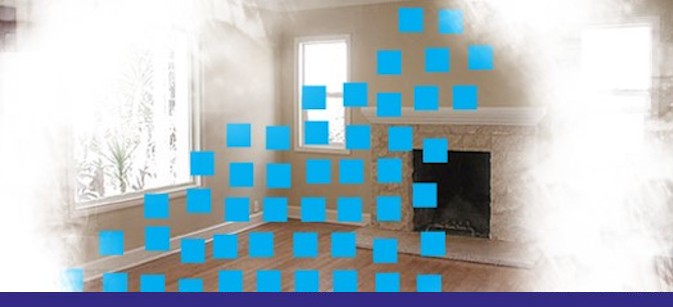

Vision loss can be a traumatic phase of life. If you then add CBS to the equation, then this can send considerable ripples through every aspect of the person's being: how they feel about themselves, its effect on their social network, their ability to perform tasks of everyday living and whether they now feel their independence “ and even their own mind- is threatened.
In this period of upheaval and uncertainty, the unusual visual experiences of CBS can feel incredibly isolating: They'll ridicule me if I speak up. Often this leads to the person keeping their CBS secret by staying at home and avoiding contact with others.
It is this sense of aloneness that can be just as crippling (if not more so) as contending with the syndrome itself. Enter the potentially valuable role of peer support.
Shery Mead, one of the pioneers of the peer support model, described it as follows:
It is about understanding another's situation empathically through the shared experience of emotional pain. When people find affiliation with others they feel are 'like' them, they feel a connection. This connection is based on mutual experience where people are able to 'be' with each other without the constraints of traditional (expert/patient) relationships." (Mead et al, 2001)
Here, the peer is a person who has a similar lived experience to you. Not the same - as everyone's life experience is unique - but they've also undergone some form of vision loss and are dealing with CBS. Unlike the standard working relationship of the health professional helping a person, peer support is seen more as a partnership whereby both can potentially learn and grow. The peer is more like an equal.
This person shares their own personal journey with CBS and touches on the issues that matter to a human being: one's place in the world, sense of self-worth, the emotional challenges such as feeling scared or alone. The peer understands these types of issues as they have gone through something comparable. It's a person reaching out to another and touches on the essence of what matters to a human being:
The peer can also become a role model of sorts. When the person comes to learn that this peer has or continues to live with CBS and yet is managing in life can give much needed hope to the person who presently feels lost or hope-less.
Peer support is available at the Foundation. At no charge, the person can be linked to another individual who lives/has lived with CBS. This individual can share their personal experiences, life challenges and gathered knowledge as to how they've managed the syndrome. Consider taking advantage of this type of support.
Contact the Foundation on 1300 121 123 or
Mead, S., Hilton, D., & Curtis, L. (2001). Peer support: A theoretical perspective. Psychiatric rehabilitation journal, 25(2), 134 - 141.
In its latest revision of the International Classification of Diseases (ICD), the World Health Organisation (WHO) formally recognised Charles Bonnet syndrome as a distinct clinical condition in June, 2019.
This updated eleventh edition (ICD-11) is the first revised version since 1990 (ICD-10). The previous version (ICD-10) had CBS fall under the general category of 'visual disturbances' but has now been clinically recognised in its own right. CBS has been allocated its own code (9D56) within the ICD-11.
The syndrome was first clinically noted in 1760 and yet ever since CBS has struggled to gain any real foothold in medical or health care spheres. Formal acknowledgement by the WHO is warmly welcomed and signifies a recognition milestone for the cause.
The ICD-11 took formal effect as of January 1, 2022 and applies to clinicians worldwide. Beyond official recognition of CBS, it is hoped that this delivers a global increase in the identification and diagnosis of the syndrome. To view the actual CBS listing within the ICD-11, please click here.
Please note that the Foundation queries the phrase 'usually temporary' to describe the duration
of the syndrome. Whilst CBS symptoms have been traditionally viewed as transient, recent studies -
as well as anecdotal evidence within the Foundation - suggests quite a different story.
Cox & ffytche (2014) found that 75% of those living with CBS had retained symptoms for at least
five years. The Foundation knows of instances where CBS has persisted well beyond a decade.
When a patient or client reports visual hallucinations (phantom imagery), one can readily assume a psychiatric or neuro-degenerative aetiology. That is, that something clinically sinister is at play. However, Charles Bonnet syndrome (CBS) is another plausible explanation that warrants consideration.
CBS belongs to a rare club: namely, visual hallucinations occurring in sane people. The reasoning faculties typically remain intact even though the affected person may exhibit anxiousness regarding their peculiar symptoms and its possible clinical implications.
Bonnet syndrome is commonly linked to some form of visual pathology (eg. macular degeneration, glaucoma, cataracts, diabetic retinopathy). It is currently estimated that ~40% of those who acquire moderate to significant vision loss will develop CBS.
CBS is typically not associated with mental illness or cognitive decline. Indeed, the CBS-affected person normally performs very well on the Mini-Mental Status Examination (MMSE) but please make allowance for the few MMSE tasks that are dependent on vision.
Unfortunately, CBS is often loosely reduced to anyone who is 'seeing things' and has some form of vision impairment. Yet this overlooks a crucial third part of the CBS triad: namely, the person is quickly able to discern that what they 'see' is not truly there. This is known as insight and is often the linchpin of the CBS diagnosis. Hence,
Then it may be advisable to ascertain whether they meet the following additional criteria:
If the patient is found to meet the above requirements and other conditions that could elicit phantom imagery have been ruled out (eg. delirium, prescribed medication side-effects), then one could provisionally make a CBS diagnosis.
| To confirm a CBS diagnosis, a neuro-ophthalmology assessment is recommended. |
Page 14 of 14
The Charles Bonnet Syndrome Foundation is dedicated to raising awareness of CBS, what signs to look out for and how to better manage this condition.
As a charitable organisation, we rely principally upon memberships and donations to continue our work.
Please help us to support more people affected by CBS.