A vision-impaired
person of sound mind experiences
phantom images (visions) in
their visual field.
National helpline
1300 121 123

A vision-impaired
person of sound mind experiences
phantom images (visions) in
their visual field.



Today, the last day of February, is Rare Disease Day. We recognise that for many people living with conditions that the medical field are not adequately aware of can lead to a long journey of isolation and confusion. Diagnosis can be 'the longest detective mission' for both the person affected and their family.
Far too often the Foundation hears accounts from people not having been forewarned by anyone within the eye health domain of Charles Bonnet syndrome. We hear of people presenting at emergency wards but leave without adequate answers. Sometimes this leads to unnecessary tests and even medications that could have been avoided if CBS had been considered from the outset.
We look forward to the day where a more inclusive and responsive health care system means that no one is left behind.
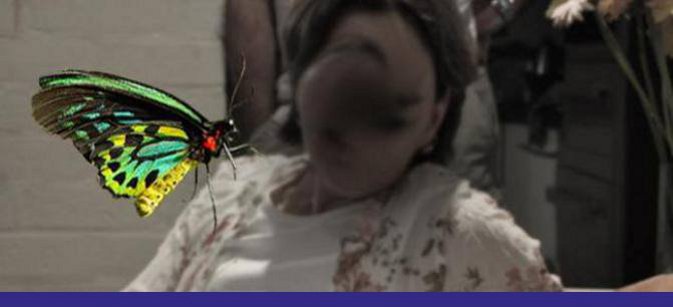
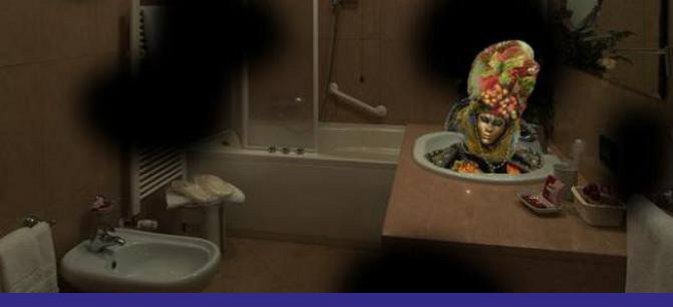
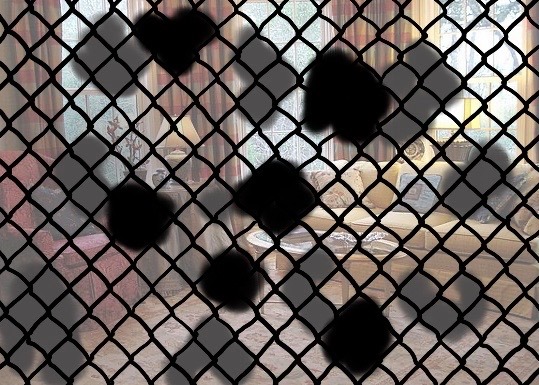
Even though more exotic tales of CBS imagery receive more attention, geometric patterns seem to be one of the most commonly experienced images. This distinct form of image occurs for somewhere between one in three to two in three people who experience the syndrome.
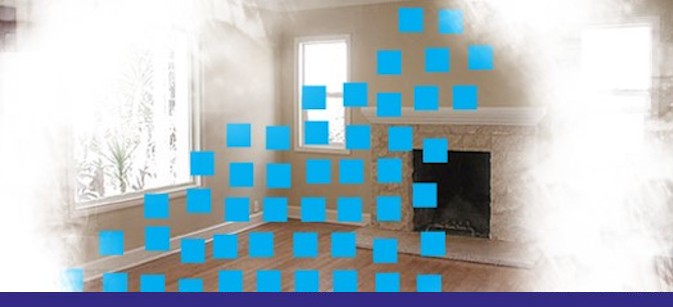
When we say geometric patterns we are referring to a wide range of styles from the simplistic such as brickwork, fence meshing, netting and grids all the way through to elaborate forms such as wallpaper, the arabesque and kaleidoscopic.
There are usually two ways these geometric patterns are experienced. One is that a certain section of a person's visual field is covered by the netting or lattice-style imagery. For example, the person looks down at a piece of blank white paper and it becomes covered by some form of regular, repeating pattern. The pattern can be in colour or black and white.
The other common occurrence is that the person experiences a particular pattern that fills their entire visual field (as below). It is experienced as like a curtain or a veil about a foot in front of the person's eyes through which they must look through. This patterned 'curtain' can be very annoying because it is often quite constant and crucially robs the person of some of their remaining vision.
The Australian Broadcasting Commission (ABC) has just broadcast a segment devoted to CBS. Featuring on Radio National's All in the Mind program, it is now available to listen to on podcast.
Hear the personal stories of three vision-impaired Australians plus insights into the syndrome from Associate Professor, Chris Plummer, a neurologist at St. Vincent's Hospital in Melbourne.
In promoting the story, the All in the Mind program states:
To listen to the program, click on the link below.
https://www.abc.net.au/radionational/programs/allinthemind/seeing-when-youre-blind/12503398

(Image courtesy of ABC)
Studies over the past twenty years have shown that people living with CBS have specific cells within the visual region of the brain that are overactive. It is believed that this overactivity is what leads to the generation of phantom images. One of the challenges has been to find ways to lower this firing of cells within the visual brain.
Transcranial direct current stimulation (tDCS) is a new electrophysiological approach, which attempts to alter brain activity in specific areas of the brain. For CBS, this technique involves introducing a gentle, low-voltage electrical current through two electrodes strategically placed on the scalp. The intention of tDCS is that the weak electrical current can counterbalance the overactivity in the visual region of the brain and thereby limit the possibility of phantom images occurring.
PhD researcher, Katrina da Silva Morgan at the Institute of Neuroscience, Newcastle University (UK) in association with King's College in London undertook a pilot study to test tDCS on CBS for the first time. All the individuals in the study were experiencing CBS throughout their waking days. From their small sample, it was found that 66% of the participants noted an improvement in their situation in two ways. First, they reported a reduction in the 'size, movement and intensity' of their phantom visions. Second, it was felt that more of their remaining vision was available to them.
These initial findings are promising but will require testing on much larger numbers of people in the future. No adverse side effects seemed to occur in any of the participants of the study, which is a further bonus as current prescribed medications for CBS often come with this risk.
Page 5 of 14
The Charles Bonnet Syndrome Foundation is dedicated to raising awareness of CBS, what signs to look out for and how to better manage this condition.
As a charitable organisation, we rely principally upon memberships and donations to continue our work.
Please help us to support more people affected by CBS.