A vision-impaired
person of sound mind experiences
phantom images (visions) in
their visual field.
National helpline
1300 121 123

A vision-impaired
person of sound mind experiences
phantom images (visions) in
their visual field.

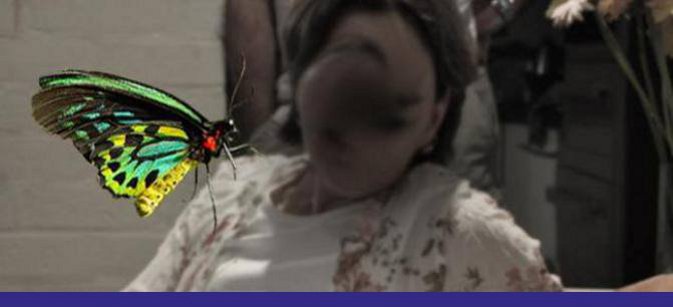


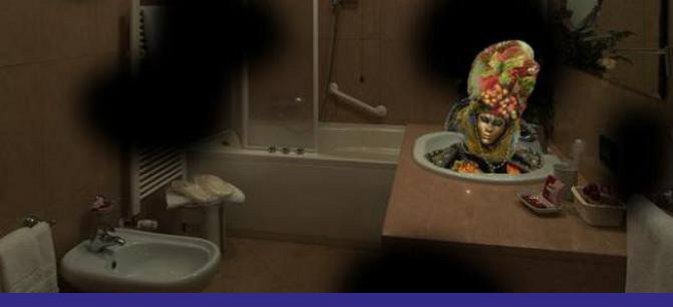


We normally trust our vision to tell us what exists out there in the world. This usually serves us exceptionally well in safely and effectively negotiating our surroundings:
It's this wonderful match between what happens within our eyes and brain and the actual world out there. This remarkably faithful mirroring is what sighted people come to rely on. But as vision starts to decline for a person, what is seen is no longer a crisp reproduction of what is out there. Maybe things become cloudy or are drained of their colour. Maybe parts of the visual field are simply lost altogether. This is to be expected when the camera of our mind becomes faulty in some sense.
Yet what is not expected at all is when this same person begins to see patterns, objects or figures often in incredible clarity and richness. The interior of the home may still continue to be hard to clearly make out but patches may suddenly spring to life with unexpected form, colour and detail. Sometimes even movement.
This is the world of Charles Bonnet syndrome where what we claim to know about vision and reality is turned upside down. This initially poses many questions because seeing is believing, isn't it? That's the natural way sighted people are wired. But what makes this syndrome truly stand out is the person soon comes to understand that what they 'see' doesn't really exist. They are visual phantoms with no substance. And this is why people living with CBS quickly grasp that seeing is not always believing.
| If you know someone with sight loss who describes seeing things that are not there, and over a period of time this person continues to claim they are real or to act as if they are, then this could be a red flag. In such a situation, consulting one's doctor for further assessment is advised. |
Albert was living with advanced macular degeneration. Nowadays he struggled to see anything clearly in everyday life. Yet bizarrely for the past few months, he'd been distinctly seeing this girl with hair ribbons who seemed straight out of the 1930s.
In the last two weeks another strange vision became a regular visitor for Albert. This time it was not a girl or a living thing but what he described as red netting. He noticed that this red netting had a slight shimmer and pulse to it and took up about a third of his visual field. Sometimes it seemed almost projected onto white surfaces like his kitchen bench or the living room ceiling. Disconcertingly, his meal was occasionally covered by criss-crossed lines of red or the netting was draped over household items like furniture.
Like the girl with hair ribbons, he was able to quickly establish that the mesh of red was not real. But unlike the 1930s girl, Albert did not really appreciate this latest addition. It was not interesting in the slightest and simply got in the way of things. Albert found it frustrating because the thick bands of twisted red robbed him of the little vision he still had left.
Yet it did make him wonder if this was the beginning of a descent into visual chaos and uncertainty. Was Albert's ordinary life about to be overtaken by visual phantoms of all shapes and sizes? Were they going to play havoc with his mind like he was a real life character in Lewis Carrol's Alice in Wonderland? Was he slowly descending into something horrifying¦ like insanity?
Albert's daughter had called the other night. At one point she said she worried about the way he had been behaving of late. There was the car incident some time back but also she'd recently noticed Albert swipe mid-air with his right arm and exclaim, "off with you". This occurred twice on separate days. Albert tried to assure his daughter that he was fine. He made up some excuse about reminiscing about his old theatrical past on the stage. He just didn't want her to worry. She had enough problems of her own. This was something that Albert felt he had to manage on his own.

One day, Albert headed off to his nearby shopping centre to get some groceries. Scrawled on a large piece of paper in thick black marking pen was his shopping list. He'd awkwardly bring the paper close to the corner of his left eye to view. With the help of sales assistants, all items had been ticked off and his shopping bag was full. He was ready to return home. As he made his way towards the exit, he was suddenly knocked to the ground by another man running past. Some of the oranges were now rolling along the shopping centre floor as Albert gathered himself. An observant and caring boy of about seven was trying to retrieve the oranges for Albert like a ball boy at a tennis grand slam.
The offending man, probably in his forties, knelt down before Albert. "Sorry mate, my fault. Are you all right?" As Albert slowly got to his feet he replied, "Yes... I think so." "Let me help you with your shopping goods," said the man as he gathered strewn items and placed back in Albert's shopping bag. Meanwhile, half a dozen oranges lay insecurely on the approaching boy's chest. The man helped relieve the boy of the fruit, "thanks kiddo... good on you". Upon returning the shopping bag to Albert he added, "I want to shout you a coffee and cake. Just here at the cafe. I'm Ben by the way."
As Albert sipped from his hot cafe latte, Ben was stirring sugar into his cappuccino. The cakes were soon to accompany them.
Ben: "So what's on for the rest of your day?"
Albert: "Not much...I used to love reading but my eyesight is so bad I can't do that these days."
Ben: "My Mum's got macular problems. It really gets to her."
Albert: "Yes, I have macular issues too."
Ben: "Last week I took her to a macular group. She got to meet others going through similar things. I think it was helpful for her. They had a guest speaker talk about this strange condition that people with macular can get. It was pretty freaky. All about blind people seeing things that are not there. They say you're not going nuts, it's just supposed to be a normal reaction by your brain to vision loss.
Albert: "Mmmm...Did they say what sort of things people see with this condition?"
Ben: "All sorts of things... plants growing out of the TV, faces floating mid-air without bodies, weird squiggly designs that move randomly. And can you believe this... apparently one woman sees the Serengeti. You know, from Africa..."
Albert: "Gosh! What's this condition called?"
Ben: "Good question... ummm... Charles something. Charles something syndrome. Don't quite remember. Luckily my mother doesn't have it but she did meet someone there whose eye doctor had explained it to her."
Albert: "My eye specialist never mentioned any of this to me."
Ben: "Yeah, they reckon they often don't. That's part of the problem."
Albert: "Charles syndrome, you said?"
Ben: "Yeah, something like that. Google it or get someone to do it for you. It'll come up."
As Albert began his solitary walk home, he felt a little tender at his left hip. He'd fallen on it earlier. Yet his mind was elsewhere: "Charles syndrome"... "not going nuts"... these phrases from Ben were turning over in his mind. He just had to learn more. It was now time to open up to his daughter and to get her involved by searching on the net.
It is often a confusing time when one first starts seeing things that are not really there. Albert's first experience happened while having lunch at his dining table one winter's day. In a moment when a soft shaft of light flooded the room, he seemed distracted by something below the table. He lowered his eyes and distinctly saw a child with pretty ribbons in her hair playing at the foot of the table. She could be seen in perfect detail: the dress material, her facial expressions and the dainty shoes she wore.
Albert was taken aback. Not only because he lived alone but also as this girl looked like she'd been plucked straight from the 1930s. She wore a traditional Bonnie Jean dress with a white rounded collar and black Mary Jane shoes. Initially he tried to speak to the girl but she never replied. He eventually reached out to touch her and to his amazement she vanished into thin air. It was the first of many encounters for Albert with the girl in hair ribbons. She often appeared in the afternoon and sometimes in the evening.
The whole experience was¦well, odd to say the least. Who was this girl? Why was she suddenly (re-)appearing? And perhaps most important of all, how on earth could Albert be seeing her so clearly? After all, he was living with advanced macular degeneration and struggled to see anything with any sort of clarity. His central vision was shot. There was this invisible hole whenever he looked straight ahead. Letters and numbers were now very hard to read and they often appeared warped. Faces seemed to get swallowed up. Driving was now very much a thing of the past. Trying to find the tin of beans from the pantry or determine what colour shirt he had selected from his wardrobe was no easy task. And yet the girl with hair ribbons was seen with no trouble at all. In fact, Albert could describe her in remarkable detail. It seemed to be a massive contradiction that made no sense.
Once when Albert was a front seat passenger in his daughter's car, he saw the girl again. This time she was riding a bike as she merrily weaved her way through the traffic. It was a bit unnerving for Albert as her movements seemed to be putting her at risk and he was concerned for her safety. He made some awkward sounds as if in acute discomfort but did not respond to his daughter's direct question, What's wrong, Dad?
Albert simply could not work it out. The 1930s girl who now made regular appearances in his life was real but also not real. He saw her clearer and better than anything else. But she never spoke and on the occasions when he extended his arm to touch her, his hand passed right through. He felt nothing but empty space. She was a phantom.
The eye specialist had told Albert he was legally blind quite some time ago and his everyday life challenges reflected this diagnosis. Except for the girl with the ribbons. She completely defied his failing vision.
To be continued
For about a third of people, Charles Bonnet syndrome is experienced as unpleasant and stressful. This outcome was recently shared by medical researchers in Portugal (Leandro et al, 2020) and mirrors an identical finding in an English study some six years prior (Cox & ffytche, 2014). It emerged from these studies that such CBS-affected people often feel they have little or no control over what is happening to them.
For the unfortunate one in three, the Bonnet images can:
|
CBS is often portrayed as pleasant but a third find the syndrome to be horrid and wish to be rid of it. |
Page 6 of 14
The Charles Bonnet Syndrome Foundation is dedicated to raising awareness of CBS, what signs to look out for and how to better manage this condition.
As a charitable organisation, we rely principally upon memberships and donations to continue our work.
Please help us to support more people affected by CBS.